An important reminder:
This post and anything on this website is for educational purposes only. It should not be used as medical advice or in place of or to delay seeking medical attention. Every child is different and has different needs. Your child’s provider can help you figure out the best management plan for your specific situation.
JUMP TO
We rearranged the kids' rooms a few weeks ago and the dresser never got re-anchored. I thought my husband did it… he thought I did it. My 4 year old opened every single drawer looking for his clothes, pulled on the last one, and the whole thing came down on him. Thankfully, he's okay with just a small bruise. But I'm a pediatric nurse practitioner and I LITERALLY TEACH this, and it still happened in my house.
So here's what I want you to take from that: baby proofing isn't something you do once before the baby comes and then check off forever. Your kiddo changes every few months. They roll, then scoot, then pull up, then climb, then figure out how to open the thing you were SURE they couldn't open. And your house changes too… You move furniture, you travel, you go to grandma's.
This guide is set up two ways. First, by age, so you know what to focus on right now and what's coming next. Then, room by room, so you can walk through your house with it. You don't have to do it all in one weekend. Start with the big stuff at the top and work your way down. I also like to tell families to plan for the kid you will have in 4-8 weeks from now.
One quick note… nothing replaces eyes on your kid. Gates and locks buy you time. They don't do the supervising for you.
Start here
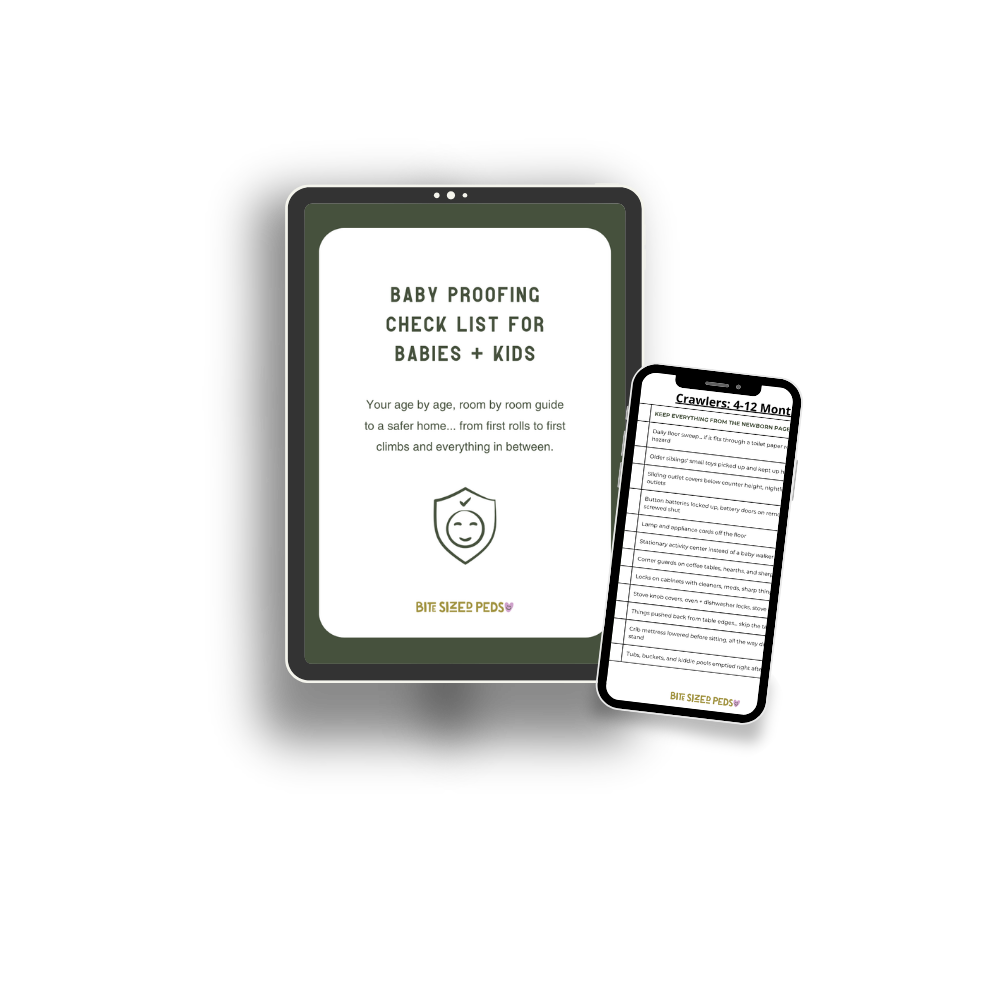
If you would rather have this in a downloadable check list, I bundled it all up here for free.
I have linked all of my favorite baby-proofing and safety items here - Baby Proofing Favorites
If you only do a handful of things, do these. Ideally before baby is even home.
Get down on the floor. Seriously… crawl around each room on your hands and knees. You'll see cords, outlets, little things under the couch, and handles that are basically a ladder from their height. You won't see any of that standing up.
Anchor every dresser, bookshelf, and TV to the wall. Into a stud if you can. Per the Consumer Product Safety Commission, about 7,800 kids a year end up in the ER from furniture or TV tip-overs, and dressers are one of the top culprits. Newer dressers sold after September 2023 have to meet a stronger stability standard (the STURDY Act) and come with an anchor kit… but older furniture and anything you've moved still needs to be anchored. Most kits are cheap and take about 10 minutes.
Safe sleep, every sleep. Baby on their back, on a firm flat surface, in their own crib or bassinet. Nothing else in there… no pillows, bumpers, loose blankets, or stuffed animals.
Turn your water heater down to 120°F or lower. Hot tap water burns little skin fast. Not that you will crank the water up that high, but babies and toddlers reach for the handles and turn it on themselves and can scald themselves.
Check your smoke and carbon monoxide detectors. Test them now and put a reminder in your phone to test them monthly.
Lock up medications, cleaning supplies, and laundry pods. Child-resistant caps slow kids down. They don't stop them.
Lock up firearms. Unloaded, locked, with ammunition stored separately and locked too. I CANNOT STRESS THIS ENOUGH. If you own a gun, it needs to be locked up. I don’t care how safely YOU handle the gun, your child is curious and will explore.
Save Poison Control in your phone right now: 1-800-222-1222. Put it on the fridge too, for sitters and grandparents.
By age: what your kiddo can do, and what that means for your house
Here's the thing about baby proofing… It's not one list. What's dangerous depends on what your kid can physically do and what their brain is curious about right now. A newborn and a 3 year old live in the same house, but they're getting into completely different trouble.
Each stage below builds on the one before it. Keep everything you did at the last stage and add the new stuff. The ages are ballparks, so go by what your kid is actually doing. And the goal is always to stay one step ahead… baby proof for the NEXT milestone, not the one they're in.
Newborn (0 to 4 months): the stage where everyone thinks they're safe
Newborns can't crawl, so it's easy to think you've got time. But they're wiggly, they push off with their feet, and a lot of babies roll for the first time somewhere they're not supposed to be… the bed, the couch, the changing table. Most injuries at this age come from falls and from what's in the sleep space. This is also the stage when you have the most control over your house, so it's the best time to knock out the big stuff before life gets chaotic.
Make sure the crib meets current Consumer Product Safety Commission standards. Hand-me-down and older cribs are worth double checking.
Crib is bare. Firm flat mattress, fitted sheet, nothing else.
Baby monitors and their cords at least 3 feet from the crib.
Never leave baby alone on a bed, couch, or changing table, even for a second. Keep one hand on them.
Car seats, bouncers, and swings go on the floor, never on a counter or table.
Replace corded blinds with cordless, or tie cords up high.
Water heater at 120°F or lower.
Gates at the top and bottom of stairs. Get them in before you need them.
Make a spot up high for purses, diaper bags, and work bags. That's where meds, gum, and hand sanitizer live.
Get in the habit of closing the toilet lid now so it's automatic later.
If you have a pool or hot tub, fence it on all four sides and add a pool alarm.
4 to 12 months: Rollers, scooters, and crawlers + Everything goes in the mouth Stage
This is when things change fast. Your baby rolls, then sits, then scoots, then crawls, then pulls up and cruises along the furniture. And every single thing they find goes straight in their mouth, because that's how they learn what something is.
Their world is basically the floor and anything they can grab from it. So the best thing you can do is get down on the floor yourself and look around from their height. You'll be surprised what you find.
Do a daily floor sweep. If it fits through a toilet paper roll, it's a choking hazard. That includes coins, hair ties, batteries, and dropped pills.
Ask older siblings and visiting kids to pick up their small toys (Legos, doll shoes, marbles) and keep them up high or in their rooms. LOL at this actually happening though. your big kids are going to want to have space to be big kids. The baby is going to be curious about that. You can designate a play space for baby that only baby toys go in and no baby toys come out. This allows you to have a safe space that is gated or blocked off that you can trust to safely set baby down in.
Sliding outlet covers on every outlet below counter height. Don't forget the kitchen island.
Take nightlights out of low outlets. They're fun to pull out and chew on.
Get cords off the floor, including lamp and appliance cords.
Use a stationary activity center instead of a baby walker. Walkers let babies move fast and reach stairs, and they're a big source of falls.
Corner guards on coffee tables, hearths, and anything sharp at their head height.
Cabinet and drawer locks anywhere you keep cleaners, meds, sharp things, or breakables.
Stove knob covers, oven lock, and dishwasher lock. Make sure the stove itself has its anti-tip bracket installed.
Keep things back from the edges of tables and counters, and skip the tablecloth for now.
Lower the crib mattress before they can sit up, then all the way down once they can pull to stand.
Empty the tub, buckets, and kiddie pools right after use. Babies can drown in an inch of water.
Toddlers (about 1 to 3 years): walking, climbing, and watching everything you do
Toddlers are fast, they climb everything, and they're starting to figure out how things work… doorknobs, latches, drawers, the step stool. They don't reliably listen to "no" yet, and they can't remember safety rules from one day to the next. That's not bad behavior; it's just where their brain is. They are quite literally learning how the world works by trying, doing, and experience.
They also copy everything you do. If they see you take a pill, they want to try it too. This is the stage where gates and locks matter most, because they're doing the work your kid's brain can't do yet.
Keep windows latched and add window stops or guards so they open no more than 4 inches. Screens won't keep a child in.
Use the back burner of stoves. If you have a gas stove, use the knob protectors on the front knobs.
Move couches, chairs, and beds away from windows, balconies, and railings so they're not a step up.
Lock doors to the outside, and add doorknob covers or locks on rooms that are off limits (garage, basement, laundry, bathroom).
Move "up high" storage even higher. Once they figure out chairs and step stools, counters aren't safe anymore.
Keep medicine in child-resistant containers in a locked or high cabinet.
Never call medicine "candy," and try not to take your meds in front of them.
Unplug small appliances and push them back on the counter.
Make a charging spot up high for phones, tablets, and anything with a button battery.
Lock up all button batteries and batteries in general.
Keep hot food and drinks in the middle of the table, not the edge.
Re-check every anchor. They're stronger now, and they will use drawers like stairs.
Pinch guards on doors, on both the hinge side and the latch side.
Preschoolers and big kids (about 3 to 5+): the more they can do, the more they find
This is the age people relax… and honestly, it does start to get a little easier, but safety still isn’t at the forefront of their little brains and they are very much still developing their risk assessment of the world around them. My 4-year-old is proof. Kids this age understand why some things are dangerous, but their impulses still win a lot. They know the cabinet is off limits, and they open it anyway. Which is also the frustrating part. They're also strong and coordinated enough to get into rooms and things you thought were handled.
The good news is you can start teaching them now. Explain why something is dangerous, but don't count on them following it every time.
Double-check your latches, locks, and gates. See if your kid has figured out how to beat them. If so, it might be time to swap out latches and locks.
Re-anchor furniture every single time it moves. This is exactly what got us.
Don't keep toys, snacks, or the remote on top of dressers or TV stands. That's an invitation to climb.
Matches and lighters locked up and out of reach.
Window stops or guards on upper floors.
Keep cleaners and meds locked up, even if they seem old enough to know better. They are still very curious
Get rid of or retrofit any toy box, chest, or trunk that can't be opened from the inside.
Firearms unloaded and locked, with ammo locked separately.
Teach them your full name, address, and phone number. but also not to willingly share that with strangers unless they are lost.
Teach them what the smoke alarm sounds like, make an escape plan, and practice it together.
Test your smoke alarms every month.
Keep watching at bath time.
Room by room : Baby Proofing Guide
Walk through your house with this. You don't need every product on the market… you need the right ones in the right spots.
Nursery and kids' bedrooms
All linked here — Baby Proofing Items
Dresser, bookshelf, and any TV anchored to the wall. Re-anchor anytime you move them.
Crib away from windows, blinds, cords, and wall decor.
Crib is bare for sleep. Firm mattress, fitted sheet only.
Lower the crib mattress as they start sitting, then pulling up.
Heaviest stuff in the bottom drawers. Nothing tempting on top of the dresser.
Diaper cream, nail clippers, and baby meds out of reach of the changing table.
Baby monitor cords at least 3 feet from the crib.
Cordless blinds, or cords tied up high.
Window stops so windows open no more than 4 inches.
Toy boxes without lids, or with lids that stay open and won't slam.
Living room
All linked here — Baby Proofing Items
TV mounted to the wall or strapped to its stand. Stand anchored too.
Bookshelves anchored.
Corner guards on the coffee table, hearth, and any sharp edges at their head height.
Fireplace: a gate around the whole hearth, hardware-mounted and set back with some distance, not just a screen. Gas fireplace glass can get over 500°F and stays hot after it's off.
Candles, breakables, and houseplants up high. Some common houseplants are toxic if eaten.
Remotes and key fobs with screw-closed battery doors.
Outlet covers and cords tucked away.
Couches pulled away from windows.
Holiday season: anchor the tree, ornaments and lights up high, cords covered.
Kitchen
All linked here — Baby Proofing Items
Locks on lower cabinets with cleaners, dishwasher pods, knives, glass, and heavy stuff.
Leave one low cabinet unlocked with safe stuff in it (Tupperware, wooden spoons). It keeps them busy.
Stove knob covers. Cook on the back burners and turn pot handles in.
Oven lock and dishwasher lock.
Knives, mandolins, and blender blades stored up high.
No hot drinks or soup near the edge of the counter or table. Skip the tablecloth for now.
Pet food and water bowls put up when you're not watching.
Vitamins and gummies stored like medicine, because they are.
Bathroom
All linked here — Baby Proofing Items
Medicine cabinet locked. All meds, vitamins, and supplements locked or up high.
Cleaning supplies, cosmetics, nail polish remover, and mouthwash locked up.
Toilet lock once they show any interest.
Drain the tub as soon as bath is over. Never leave them alone in the tub, not even for a second.
Bath seats and rings aren't safety devices. They can tip.
Curling irons, flat irons, and hair dryers unplugged, cooled, and put away with the cords wrapped up. They stay hot long after you turn them off, and a dangling cord is all it takes. Razors put away too.
Doorknob cover so they can't wander in alone.
Stairs and hallways
All linked here — Baby Proofing Items
Gates at the top and bottom. Hardware-mounted at the top of stairs, never pressure-mounted. Pressure gates can pop loose.
Railings and banisters: if the gaps are wider than 4 inches, add a guard.
Pinch guards on doors, on both the hinge side and the latch side.
Stairs clear of shoes, toys, and laundry baskets.
Laundry room and garage
Laundry pods and detergent locked up. Pods look like candy.
Washer and dryer doors closed.
Gas, antifreeze, windshield fluid, paint, and pesticides up high and locked.
Tools and power tools put away.
Garage door auto-reverse tested. Keep the opener out of reach.
Extra lock up high on the door into the garage.
Outdoors and pool
Pools fenced on all 4 sides with a self-closing, self-latching gate.
Empty kiddie pools, buckets, and coolers after use.
One adult is the designated water watcher. No phone.
Check the yard for toxic plants, mushrooms, and anything they can climb to get over a fence.
Grills, fire pits, and lawn mower off limits.
In the car
Rear-facing as long as possible, until they max out the seat's height or weight limits.
Get your car seat install checked by a certified technician.
Always look before you lock. Put your phone or bag in the back seat so you never forget a sleeping baby.
Lock the car in the driveway so kids can't climb in on their own.
When you move, rearrange, travel, or go to grandma's
This is where it slips, and it's exactly where it slipped for us. You did all the work once, then life happens and the house changes around you.
Every time you move furniture, re-anchor it before the kids are back in the room. Make it part of the job, not a "we'll get to it later." Decide out loud who's doing it so nobody assumes.
When you get somewhere new (grandparents, a rental, a friend's house), do a quick 5 minute scan before you set them down. Look for medications on nightstands and in purses, cleaning supplies under the sink, small stuff on low tables, pet food, stairs without gates, and pools or ponds.
Ask nicely and specifically. "Can we move your pill organizer up high while we're here?" lands better than "is your house baby proofed?" Grandma's purse is one of the most common places kids find medication.
Bring a few things with you: a portable gate, a travel crib or play yard, a handful of outlet covers, and a couple of strap locks. They don't take up much room.
If something does happen
Even with all of this, kids get hurt. That's part of being little. What helps most is knowing what to do in the moment.
If they swallow something they shouldn't, call Poison Control at 1-800-222-1222, even if they seem fine. If they're having trouble breathing, having a seizure, or won't wake up, call 911.
If they swallow a button battery or magnets, go to the ER right away. Don't wait for symptoms.
If furniture or a TV falls on them, or they hit their head in a fall, get them seen if they lose consciousness even for a second, vomit, seem extra sleepy or confused, aren't acting like themselves, or you're just worried. Trust your gut.
If they're choking, you need to know what to do before it happens, not during. That's exactly why I teach our Baby + Child CPR, Choking and First Aid class. We go through choking, CPR, and how to tell when it's an ER trip versus something you can watch at home. You'll leave feeling like you can actually handle it.
Save this, share it with your partner and whoever watches your kids, and come back to it every time your little one hits a new milestone.
This post is for educational purposes only and is not a substitute for professional medical advice or emergency medical services. Always consult your provider for guidance on your child's specific needs.
If you want to have this all in one place to hang on the fridge, you can print the free check list here
Before you go
If you're in the thick of a new baby, about to bring a baby home, and you’re overwhelmed trying to piecing it together from fifteen different Instagrams…we would love to help you prepare with our courses! Check them out here We also have tons of other safety and first aid resources to browse from!
-
Medical/General: The content, information, opinions, and suggestions listed here have been created with typically developing children and babies in mind. The information here is generalized for a broad audience. The information here should by no means be used as a substitute for medical advice or for any circumstance be used in place of emergency services. Your child is an individual and may have needs or considerations beyond generally accepted practices. If your child has underlying medical or developmental differences, including but not limited to prematurity, developmental delay, sensory processing differences, gastrointestinal differences, cardiopulmonary disease processes, or neurological differences, we strongly recommend you discuss your child's plan with the child's doctor, health care provider. By accessing this site and the information in it, you acknowledge and agree that you are accepting responsibility for your child’s health and well-being. By using and accepting the information on this site, the author (Cierra Crowley) is not responsible for any adverse effects or consequences resulting from the use of any suggestions discussed. It is important to talk to your child’s pediatrician or medical provider to start anything new or make any changes.
Affiliation: this page contains affiliate links from which I can earn small commissions (at no additional cost to you).
-
Babyproofing Checklist and Baby Safety Guide, Consumer Reports
New CPSC Report on Tip-Over Injuries and Deaths, Kids In Danger
Anchor It!, CPSC
Preventing Furniture and TV Tip-Overs, AAP / HealthyChildren.org
What Parents Need to Know about Button and Lithium Coin Batteries, AAP / HealthyChildren.org
Water Safety and Young Children, AAP / HealthyChildren.org
Cierra Crowley, MSN, CPNP is a board-certified Pediatric Nurse Practitioner, adjunct assistant professor, and mom of three. She is the founder of Bite Sized Peds, a pediatric health education platform serving families and pediatric professionals.
This post is for educational purposes only and does not constitute medical advice. Always consult your child's pediatrician with specific concerns about allergen introduction or food allergies.