Soak Up the Sun and Fun Without the ER Run — Your Summer Safety Guide for Kids
An important reminder:
This post and anything on this website is for educational purposes only. It should not be used as medical advice or in place of or to delay seeking medical attention. Viewing, interacting with, or following this website, its content or affiliations, does not establish a provider-patient relationship. Additionally, the education provided on this account is made with typically developing children in mind. Your child may have different development and medical needs. Your child’s provider can help you figure out the best management plan for your specific situation.
Summer is my favorite season as a mom. Getting to watch my babies play, be kids, the chaos, the water and sun time, the late bedtimes that I pretend aren't happening. All of it. But after 13 years in pediatrics — PICU, surgery, trauma surgery, public health, and now your neighborhood community educator — I can also tell you that summer is when my fellow pediatric providers start bracing for impact. The ER visits go up, the accidents, the water incidents…. And most of it is preventable.
I don't say that to scare you. Fear-mongering is not my thing, and it never will be. I say it because you are clearly the kind of parent who wants to be prepared, and that's exactly what this post is for. Let's talk about the most common summertime injuries I see in kids, what you actually need to know, and how to feel genuinely confident going into this season.
Here's what we're covering: burns, sunburns, drowning, head injuries and trauma related injuries, and heat-related illness — plus a quick roundup of general summer safety tips to tie it all together.
Burns
Burns are one of the most common injuries in young children year-round, but summer brings a specific set of risks — campfires, marshmallow roasting, grills, sparklers, fireworks, and hot pavement or surfaces (like decks) that get overlooked. According to the American Burn Association, children under five are at the highest risk of burn injuries, largely because their skin is thinner and more vulnerable than older kids and adults. That means what might cause a minor irritation on your skin can cause a significant burn on your toddler.
Burns in kids can be caused from hot liquids, hot surfaces, chemical burns, electrical burns, flame burns, friction burns, and sunburns.
The most important thing I want you to know about burns is that the severity depends on mechanism of burn (chemical, electrical, and flame burns = serious) contact time, depth, and surface area (how large the burn is).
We’ll talk about what to do for burns and when to seek care in a second.. But our best friend for burns is going to be prevention. So here are some important burn safety reminders
Keep young children a safe distance from grills, campfires, and fire pits at all times. Designate a clear boundary — physically, not just verbally — because toddlers are not great at honoring invisible lines. Similar to water safety, an adult is supervising the area at all times.
Sparklers burn at around 1200 degrees Fahrenheit and are responsible for a significant portion of pediatric fireworks injuries each year, so they are not the "safe" fireworks alternative many parents think they are. If fireworks are happening, the best seat for little ones is on a lap, far back, watching the professionals handle it.
Hot pavement/surfaces: if your hand can’t touch the surface for five seconds, your child’s feet can’t be on it. Sand, asphalt, concrete, glass table top surfaces … they all heat up so fast in the summer sun. Keep shoes on your little one’s feet when moving between water and dry areas and check surfaces before letting your baby or toddler walk on them barefoot. My nephew (2.5 years old at the time) climbed up on my sister’s glass table two summers ago in the heat of the summer here in Missouri and got second degree burns on the bottom of his feet!
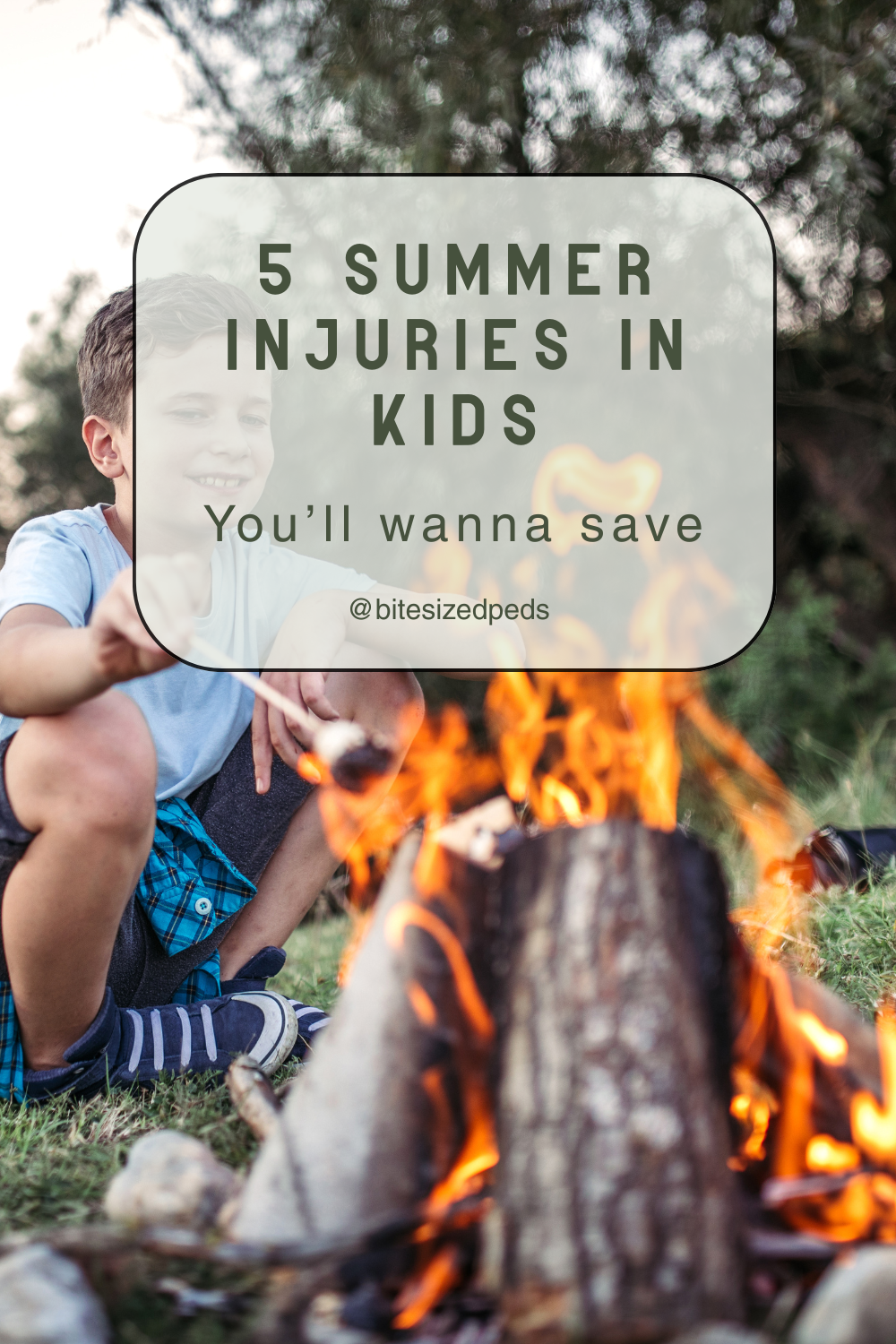
Let the adults do the marshmallow roasting! I know there is nostalgia with it for the kids, but toddlers and honestly preschoolers have no business being that close to open flames. They still need help.
Garden Hoses: Hoses typically sit outdoors in direct sun, sometimes with water still sitting in them from the last use. That stagnant water can get scalding hot, and be the first thing that reaches skin, before the cool water comes out from the spigot… Every single time you turn the hose on, point it away from everyone, including yourself and little ones, and let it run for a few seconds before anyone gets near it. Teach your kids to not turn the hose on without an adult and to always use the same habit when turning the hose on.
Unplug all hot heating tools
Turn pots and pan handles towards the back of the stove, and even try to use the back burners so kids can’t reach them.
Check the water temperature of your water heater to prevent scalding burns indoors.
Call your doctor or seek care if:
Good rule of thumb any burn that is greater than 1 inch (about the size of a quarter) with a blister needs to be looked at by a medical provider.
Any burn in a baby under 12 months warrants a call.
These need urgent evaluation
Burns larger than 4 of your child’s hand size, burns on the face, hands, feet, genitals, or over a joint, looks white or leathery, or is greater than 2 inches and blisters significantly need urgent evaluation.
Any burn caused by house burns, explosions, chemicals, electrical current need emergent evaluation.
Burn first aid:
Immediately run the burned part in cool running water for 20 minutes. This is so important to help stop the burning process - lessen the burn and help with pain.
Do NOT use ice or ice packs
For burns on the face, apply a cool, wet washcloth. Reapply a cool, wet, washcloth every few minutes for 20 minutes.
Remove any burned or contaminated clothing
If it is a chemical burn, flush the chemical off the skin for 10-20 minutes.
Offer pain medication as needed (tylenol or ibuprofen as directed by your provider)
Clean the burn with water and a mild soap if needed.
Leave intact blisters alone. Don’t open them. The blistered skin is protecting the underneath layers and helping prevent infection.
If the burn has opened you can apply an antibiotic ointment and cover with a non-adhering gauze pad.
Don’t use butter, toothpaste, ice, burn cream..
Sunburns
Let's talk about something that feels minor but can be a big deal especially in babies and young children. A sunburn in childhood isn't just uncomfortable in the moment. Children's skin is more sensitive than ours, which means they burn faster and more deeply than we do in the same amount of sun exposure.
For babies younger than 6 months, their skin is even more sensitive and highly absorbent which increases their risk for chemical absorption from sunscreen. The AAP recommends to
keep them out of direct sunlight altogether
Shade, a canopy
Lightweight long sleeves, a hat, and decrease overall time in the sun
For babies 6 months and older and all kids beyond that, you can still use some of these sun reduction techniques but you can also use sunscreen. Check out my full sunscreen guide for babies here. But the short version is: look for mineral-based sunscreens with zinc oxide or titanium dioxide, SPF 30 or higher, and apply it 15 to 30 minutes before going outside. Reapply every two hours and immediately after swimming or sweating — even if the bottle says water resistant.
Beyond sunscreen, sun-protective clothing makes a huge difference and honestly requires less reapplication stress. Look for items labeled with a UPF (Ultraviolet Protection Factor) rating. A lightweight long-sleeved shirt and a wide-brimmed hat that covers the ears and back of the neck are summer essentials for little ones. Try to limit direct sun exposure between 10am and 4pm when UV rays are strongest, and make shade your best friend during those peak hours.
If a sunburn happens:
Get your child out of the sun immediately.
Offer extra fluids — sunburned skin loses moisture, and dehydration can sneak up quickly in kids.
Cool compresses or a lukewarm bath can help with comfort.
For older babies and toddlers, age-appropriate dosing of acetaminophen or ibuprofen (ibuprofen for 6 months and older only) can help manage pain.
Only use medicated lotions or topical numbing products if your child's doctor has specifically okayed them.
Call your doctor if:
Your baby is younger than 1 year old and gets sunburned — call right away.
For older children, call if there is blistering, significant pain, or fever. Blistering means a deeper burn and often warrants medical evaluation.
Drowning
This one is hard to write about because the statistics are devastating — and because drowning is so silent and so fast that it catches even the most attentive parents off guard. Drowning is the leading cause of accidental death in children ages 1 to 4 in the United States, according to the CDC. It can happen in pools, lakes, bathtubs, buckets, and even small decorative fountains. It does not look like it does in the movies. There is no splashing, no yelling, no dramatic flailing. It is quiet, and it is fast.
I'm not saying that to terrify you out of enjoying the pool this summer. I'm saying it because the parents who know this are the ones who stay close, stay off their phones at the water's edge, and take water safety seriously every single time — not just when they remember to.
Check out my whole blog post on water safety, non-negotiables to help keep your kids safe and
Know CPR. This is where I'll always land because it is the single most important skill you can have as a parent near water. Our Baby + Child CPR + First Aid + Safety class exists exactly for this reason. Find a class here
Head Injuries and Trauma
It’s summer, our kids are outside more, it’s the PERFECT time for them to be kids and ride bikes, and scooters. But with summer also means the increase in ATV use (4 wheelers, golf carts, side-by-sides) and e-bikes and e-scooters, hoverboards…. all of them carry real risk, some more than others. Kids are naturally going to bonk their head. It isn’t completely avoidable. Especially when they are adventure seeking and just being kids. But we want to try and minimize the more serious ones.
Your child only gets one noggin and one brain.. We gotta protect it!
For bikes and scooters, a properly fitted helmet should sit level on the head, about two finger-widths above the eyebrows, with the straps forming a "V" shape under each ear and snug enough that you can only fit two fingers under the chin strap. If it rocks back or forward, it's not right. Check the fit every season because kids grow fast.
For e-bikes, e-scooters, and ATVs, the stakes are higher because speeds are higher. Many childhood injuries on e-bikes and e-scooters involve kids who weren't wearing helmets at all, or who were wearing bike helmets on vehicles that require more protection. ATVs especially are associated with serious injury in children — the AAP actually recommends children under 16 not ride adult-sized ATVs, and children under 6 should not ride ATVs at all.
For all sporting activities — think baseball, football, horseback riding, skiing— make sure the appropriate sport-specific helmet or head protection is being used and is in good condition. Helmets do wear out and after a significant impact they should be replaced even if they look fine on the outside.
Let this be one of those non-negotiable things for your kids… kind of like brushing their teeth. My kids know our saying like the back of their hand now “When there’s wheels under our feet, there is a helmet on our head”. It was never allowed to be a discussion. If they don’t want to wear a helmet, they don’t get to ride.
Your kid bonked their head…. Now what
Our kids are GOING to bump their head at one point or another in their lives. Especially toddlers and babies who are very top heavy.. instead of panicking, embrace that it is going to happen, but there are things we can do to prevent it (at the end of this section) and things we want to watch for that require emergency care… and what we can do at home if it isn’t any of these emergency symptoms
Emergency room
Large dent in the skull
Skin is split open or gapping
Bleeding that won’t stop after 10 minutes of direct pressure
Injury caused by a motor vehicle accident
Fell from higher than 3 feet in a 2 year old
Fell from higher than 5 feet in > 2 years
Vomited more than 2 times in 24 hours of injury
Severe headache or high pitched crying not improving
Call 911 if
Difficult to wake up or are confused and have slurred speech
They had a seizure after hitting their head
Knocked unconscious for more than one minute
Not moving their neck normally within 1 hour of injury
Major bleeding that you can’t stop
Head injury first aid At home
If there is a scrape or cut, wash it off with soap and water
Use a cold pack for pain and swelling
Watch closely for 2 hours. It is okay if they rest and sleep if they want. But keep them nearby and wake them after 2 hours to check if they are responding to you and can talk and walk.
Pain medication as needed (Acetaminophen or ibuprofen as directed by your pediatrician).
Lots of TLC and popsicles and snuggles!
Seek care if their pain or crying becomes worse vomiting occurs more than 2 times, they become difficult to awaken, walking or talking becomes difficult, baby that is increasingly irritable
Preventing Head Injuries
The most common causes of head injuries in kids are falls, motor vehicle incidents, sports injuries and child abuse. While not all head injuries are preventable, in some cases, parents, caregivers and other trusted adults can take steps to avoid injuries or lessen their severity. Here are some tips on how to keep kids safe:
Home safety tips
Keep furniture away from windows and install child-proof screens and/or guards on any windows that can be opened. Close and lock any doors that lead to decks or balconies.
Install safety gates at the top and bottom of the stairs until a child is old enough to go up and down safely on their own.
Anchor large pieces of furniture to the wall to prevent them from tipping over, and move any smaller household items, such as lamps or pictures, that a child could pull down on themselves.
Never leave a baby or toddler unattended on a high surface, such as a couch or countertop.
Look at your home from your child’s perspective and make any additional changes that could lead to a head injury. Learn more about baby proofing in one of our upcoming classes
Car safety
Make sure that your child is in the right car seat at every phase and rear facing for as long as possible.
Always ensure that your child is buckled into a properly installed car seat, booster seat or seatbelt anytime that you’re driving in the car.
Eliminate distracted driving
Sports and recreational safety
Make sure your child is wearing proper head protection for any sports they’re participating in. Helmets always for collision sports like football, rugby, hockey and outdoor activities that carry a risk of falling from a height.
If your child is riding bikes, skateboards, scooters, or anything on wheels, make sure they do so responsibly and wear a properly fitting helmet. Teach them to stop at stop signs, use crosswalks, look both ways before crossing streets and stay on side walks.
Check with your local sporting organization to make sure they are taking proactive measures to reduce the risk of head injuries in youth sports.
Heat Stroke and Overheating
This one has to be talked about clearly and without softening the edges: children left in hot cars die. It can happen in as little as 10 minutes. The temperature inside a parked car can rise nearly 20 degrees in just 10 minutes, and nearly 30 degrees within 20 minutes — regardless of whether the windows are cracked.
Every 10 days a child dies in a hot car…
Young children are particularly at risk of heat related injury and illness, as their bodies heat up three to five times faster than an adult’s.
Kids can get into cars without you knowing — they see a toy inside, playing hide-and-seek, or want to play pretend “drive” like mom and dad.
The data shows that the majority of hot car deaths involve a caregiver who had a change in routine or simply forgot. All of us are capable of distraction and habit-based autopilot.
Build a habit of always checking the backseat before walking away from the car — put your phone, your bag, or your shoe in the backseat as a physical reminder if you need to.
Create reminders. Keep a stuffed animal or other memento in your child’s car seat when it’s empty, and move it to the front seat as a visual reminder when your child is in the back seat. Or place and secure your phone, briefcase or purse in the backseat when traveling with your child.
Take action. If you see a child alone in a car, call 911. Emergency personnel want you to call. They are trained to respond to these situations
Beyond cars, heat-related illness is a real risk for active kids in summer heat. Children overheat faster than adults because their bodies are less efficient at regulating temperature. It can happen from prolonged sun exposure, excessive physical activity in the heat, or over exertion.
Infants are at a higher risk because they are unable to sweat to help cool themselves.
Heat cramps are the most common reaction to strenuous exercise and heat exposure. They are usually mild but can be quite painful. Heat cramps typically clear in 1-2 hours with rest and hydration.
Early signs of heat exhaustion to watch for include
heavy sweating, pale or flushed skin, weakness, dizziness, nausea, and a headache.
If you notice these signs,
get your child to a cool area immediately
Have them lie down with their feet elevated
remove extra clothing so the body surface can give heat off
Sponge the entire body surface continuously with cool water (not cold water that might cause shivering)
offer cool fluids as much as the child can tolerate
Because signs of heat exhaustion can progress to a heat stroke, if your child can not tolerate fluids and rest, it is best to have them evaluated by a medical professional.
Heat stroke is a medical emergency. Signs include
a high body temperature (often 104°F or higher)
hot and dry OR hot and sweaty skin
Confusion
rapid breathing
and loss of consciousness.
Call 911 immediately and move them to a cool shady place or in the AC and elevate their feet
While you wait, cool them down as fast as possible Sponge the entire body surface continuously with cool water (not cold water that might cause shivering)
If they are awake and conscious, give as much cold water as they can tolerate.
Prevention:
dress kids in lightweight, light-colored, loose clothing.
Schedule outdoor activity in the morning or evening when it's cooler.
Make sure kids are well hydrated before going outside, not just during and after.
And don't forget that babies and toddlers can't tell you they're hot — watch for fussiness, flushing, and decreased activity in the heat.
Create reminders. Keep a stuffed animal or other memento in your child’s car seat when it’s empty, and move it to the front seat as a visual reminder when your child is in the back seat. Or place and secure your phone, briefcase or purse in the backseat when traveling with your child.
Take action. If you see a child alone in a car, call 911. Emergency personnel want you to call. They are trained to respond to these situations
Keep your cars locked when not in use. EVEN IN THE GARAGE. Check the back seats before locking.
Keep the keys out of reach of the children.
Don’t give your kids the keys or key fob to play with.
Ask visitors to do the same
Teach your kids that the car isn’t a play area and they should never go into one by themselves.
If they need something in the car to grab an adult.
Make sure that if your child knows how to get into a car, they know how to get out and if they can’t get out……
TEACH THEM TO HONK THE HORN on REPEAT if they can’t get out.
General Summer Safety Tips Worth Repeating
Know basic first aid and CPR. Not just "know of it" — actually know how to do it. There is a difference between reading a blog, seeing a social media post, and ACTUALLY practicing and learning from a pediatric expert. Our Baby + Child CPR + First Aid + Safety class covers choking, breathing emergencies, burns, head injuries, allergic reactions, heat injuries, and so much more. Being trained means you act instead of freeze when it matters. [LINK]
Keep a well-stocked first aid kit at home and in the car. [LINK to first aid checklist] or check out our travel first aid kit!
Sunscreen + hydration + shade = your summer triangle of protection. Oh and HELMETS! There are many organizations that offer free bicycle helmets for kids, you can Google them near you!
The Bottom Line
Summer is made for your kids. For the memories, the mess, the pure joy of a kid running through a sprinkler. None of this information is meant to put you on edge every time you walk out the back door. It's meant to put you in the position of someone who is informed, prepared, and confident — because that's exactly what your kids need you to be.
If something feels off, trust that instinct. Your child's provider would always rather take the call than have you sitting at home unsure.
You've got this. Now go enjoy the summer!
-
Medical/General: The content, information, opinions, and suggestions listed here have been created with typically developing children and babies in mind. The information here is generalized for a broad audience. The information here should by no means be used as a substitute for medical advice or for any circumstance be used in place of emergency services. Your child is an individual and may have needs or considerations beyond generally accepted practices. If your child has underlying medical or developmental differences, including but not limited to prematurity, developmental delay, sensory processing differences, gastrointestinal differences, cardiopulmonary disease processes, or neurological differences, we strongly recommend you discuss your child's plan with the child's doctor, health care provider. By accessing this site and the information in it, you acknowledge and agree that you are accepting responsibility for your child’s health and well-being. By using and accepting the information on this site, the author (Cierra Crowley) is not responsible for any adverse effects or consequences resulting from the use of any suggestions discussed. It is important to talk to your child’s pediatrician or medical provider to start anything new or make any changes.
Affiliation: this page contains affiliate links from which I can earn small commissions (at no additional cost to you).
-
Centers for Disease Control and Prevention. (2024). Drowning data and facts. https://www.cdc.gov/drowning/data-research/facts/index.html
Centers for Disease Control and Prevention. (2024). Risk factors for drowning. https://www.cdc.gov/drowning/risk-factors/index.html
Centers for Disease Control and Prevention. (2024). Drowning increases in the U.S. Vital Signs. https://www.cdc.gov/vitalsigns/drowning/index.html
Dayimu, A., et al. (2025). Initial pediatric burn management: A practical guide. PMC.https://pmc.ncbi.nlm.nih.gov/articles/PMC11090655/
Healthy Children / American Academy of Pediatrics. Sun safety. https://www.healthychildren.org/English/safety-prevention/at-play/Pages/Sun-Safety.aspx
Healthy Children / American Academy of Pediatrics. Sunburn treatment and prevention. https://www.healthychildren.org/English/health-issues/conditions/skin/Pages/sunburn-treatment-and-prevention.aspx
Healthy Children / American Academy of Pediatrics. (2022). Helmets save lives and significantly reduce risks of traumatic brain injury. https://www.healthychildren.org/English/news/Pages/AAP-helmets-significantly-reduce-risks-of-traumatic-brain-injury.aspx
Healthy Children / American Academy of Pediatrics. Prevent child deaths in hot cars. https://www.healthychildren.org/English/safety-prevention/on-the-go/Pages/Prevent-Child-Deaths-in-Hot-Cars.aspx
Li, Y., Wu, J., & Cao, Z. (2023). Childhood sunburn and risk of melanoma and non-melanoma skin cancer: A Mendelian randomization study. Environmental Science and Pollution Research.https://pmc.ncbi.nlm.nih.gov/articles/PMC10724097/
National Highway Traffic Safety Administration. You can help prevent hot car deaths. https://www.nhtsa.gov/child-safety/you-can-help-prevent-hot-car-deaths
National Drowning Prevention Alliance. Drowning facts and data. https://ndpa.org/drowning-facts-and-data/
Penfield, C.S., et al. (2020). Bike helmets prevent pediatric head injury in serious bicycle crashes with motor vehicles. PMC. https://pmc.ncbi.nlm.nih.gov/articles/PMC7291179/
Sacks, J.J., et al. (2022). Helmet use in preventing head injuries in bicycling, snow sports, and other recreational activities and sports. Pediatrics, AAP. https://publications.aap.org/pediatrics/article/150/3/e2022058878/188764
Texas Department of State Health Services. (2025). After four hot car deaths in two weeks. https://www.dshs.texas.gov/news-alerts/after-four-hot-car-deaths-two-weeks-texas-health-officials-urge-adults-never-leave