Water Safety for Babies and Kids: What Every Parent Needs to Know Before the First Swim of the Season
An important reminder:
This post and anything on this website is for educational purposes only. It should not be used as medical advice or in place of or to delay seeking medical attention. Every child is different and has different needs. Your child’s provider can help you figure out the best management plan for your specific situation.
Summer is here, and that means pools ALLLL the outdoor activities and water time. Pools, lakes, splash pads, ocean vacations, and all the water fun that comes with warmer weather. I am completely here for it, and could honestly use one of those ocean vacations right about now! Getting outside, making memories, letting the kids run and splash, with their sun-kissed hair and skin is genuinely one of my favorite things.
But it also means this is the time of year I feel the most urgency to talk about water safety. Not to scare you… you know that's not how I do things. But because the more informed and prepared you are going into a pool day, the more confident you feel, and that confidence is what actually keeps your kids safe.
So let's get into it.
Let’s hit the scary but important statistics first
Drowning is the number one cause of accidental death in children ages 1 to 4. Let that land for a second. Not car accidents. Not falls. Drowning. And for kids ages 5 to 14, it's the second leading cause of accidental death. These numbers come from the CDC, and they are exactly why I talk about this every single summer without apology.
Here is the part that catches parents most off guard: drowning does not look like what you see in movies. There is no splashing, no screaming, no dramatic warning that something is wrong. It happens fast, we are talking seconds, and it happens quietly. A child can slip under the surface and be in serious trouble before anyone nearby even realizes something has changed.
And it is not only deep water you need to think about. Babies and young toddlers can drown in just a couple of inches of water. Bathtubs, wading pools, five-gallon buckets, coolers full of melted ice — these are all real risks for the littlest ones in your house. Most infant drowning deaths in the home happen in the bathtub, and the majority of those involve babies under one year old.
I share all of this not to send you into a spiral, but because knowing where the risk actually lives helps you make a real plan. And you absolutely can make a real plan.
Because as a pediatric nurse practitioner, I never want to have to hear another parent ever again say the words “but I was right there… it all happened so fast” …
Non-Negotiables By the Water
These are the things I follow with my own kids every single time we are near water. No “i’ll go do this real quick” or “this will just take one second” or “it’ll be fine just this once” …..
One designated Water Watcher — and you say it out loud.
This is the one I cannot emphasize enough. And I think it's because it feels unnecessary when you're surrounded by other adults. Here's the problem: when everyone assumes someone else is watching, no one is actually watching. At a pool party, a lake day, a backyard barbecue with a body of water nearby — before the kids get in, one adult is designated out loud as the Water Watcher. Not implied. Said. "I've got eyes on the kids right now." Or make it a physical hand-off, like a high five, to signal changing of supervision. You take turns, you rotate, but there is always one person whose only job in that moment is watching the water. DISTRACTION FREE..
No phone, no alcohol while you are the Water Watcher.
I know….. I know….. I know the pool is also where you want to relax and catch up with your people. But if you are the designated Water Watcher in that rotation, the phone is down and the drink can wait. Drowning happens in the time it takes to read one text. That is not an exaggeration. When it is someone else's turn to watch, then you relax. The system only works if everyone actually follows it. No reading, no scrolling, no grabbing a drink, no alcohol. Eyes on the kids with clear ability to react quickly.
Within arm's reach for young children
For babies and young toddlers especially, close and constant supervision means you are close enough to reach them immediately if something happens. Even if there is a lifeguard. Even if your child has had swim lessons. Even if the pool is shallow. It seriously happens so fast, and young kids are curious, still learning safety skills, and sometimes don’t have the best judgement of their abilities or inabilities.
The ask-first rule
This is a habit you build early and you enforce consistently. Kids ask before they get in the water. Every time. No exceptions. Whether it's the backyard kiddie pool or the neighborhood pool, they look at you, they ask, you give the green light. It sounds simple and it is, but the repetition is the whole point. You want this to be so automatic for your child that they do not even think about getting in water without checking in first. This can be a high five, a thumbs up, whatever your family's signal is, but they wait for it.
Puddle jumpers and water wings are not life jackets — full stop.
This might be the most important gear conversation of the whole summer. Puddle jumpers, water wings, arm floaties…they are water tools, not safety devices. They are not approved to prevent drowning. They can slip off, especially when a child jumps into the water. They can actually position a child vertically in the water in a way that makes it harder, not easier, for them to right themselves. And the biggest issue with them is the false sense of security they create — for parents and for kids. A parent sees their child in a puddle jumper and unconsciously relaxes their supervision. A child wearing one starts to believe they are safe without adult support nearby. Neither of those things is true. Not to mention a false confidence this gives a child of their swim abilities.
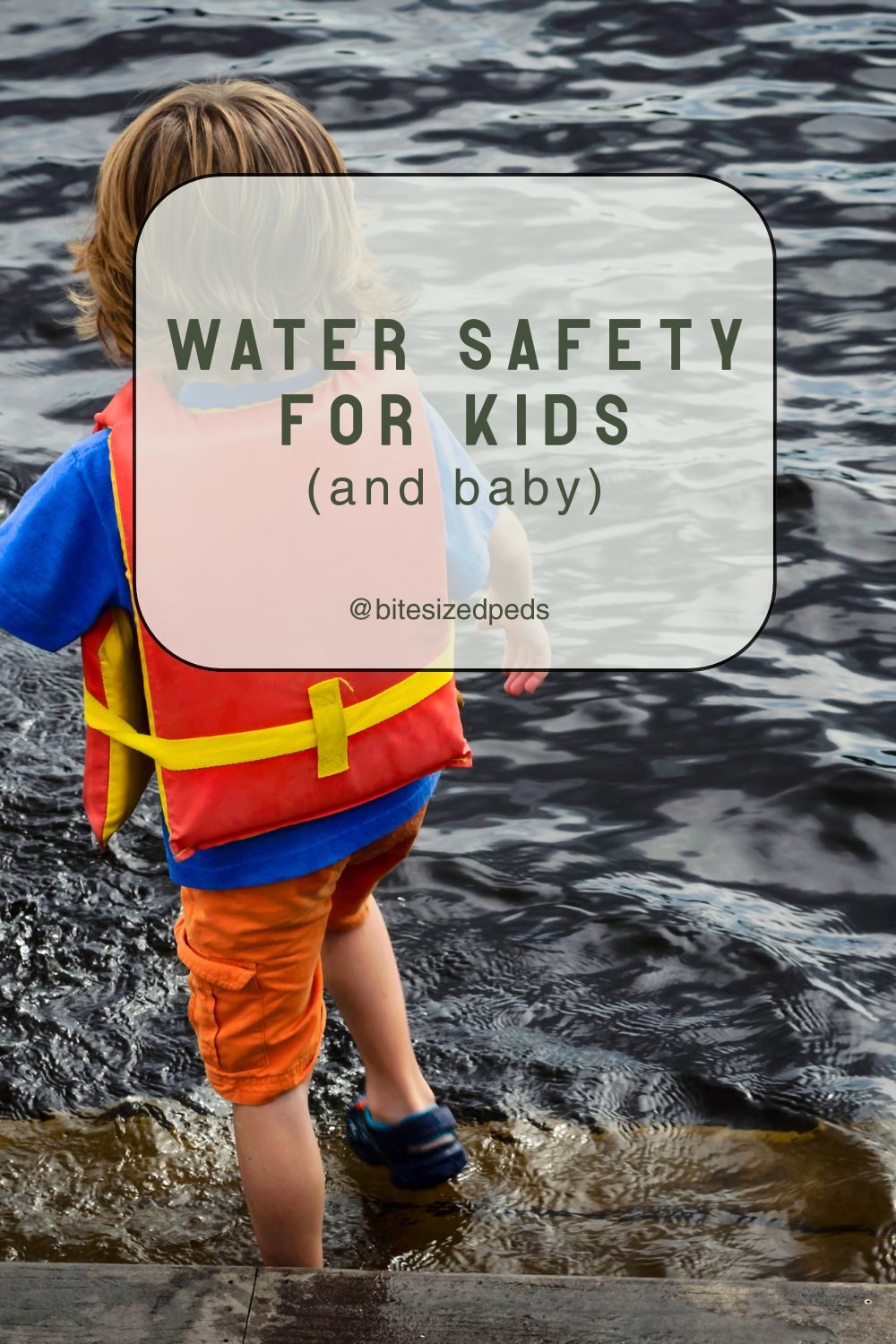
What you actually want is a U.S. Coast Guard (USCG)-approved life jacket, properly fitted to your child's weight, not their age. It should be fully fastened every time.
The most common types of USCG are Type II (designed to turn an unconscious child face-up) and Type III (maintains a face-up position but requires the wearer to be conscious). For most toddlers, a Type II or Type III rated for under 30 lbs or 30-50lbs is the right range.
Always check the life-jacket for the USCG approval stamp.
Swim lessons early, and water exposure often.
Swim lessons reduce drowning risk. And the earlier kids are comfortable and familiar in the water, the better. Most children are developmentally ready for formal swim lessons around age 4, but infant and toddler water classes before that are a wonderful way to build comfort, reduce fear, and start establishing good habits in and around water. Just know this: swim lessons are not a guarantee of safety and they do not replace supervision. A child who has had lessons still needs you watching. Lessons and supervision work together — they are not interchangeable
Build safe water habits early on
Safety by the water is not a one-time conversation. It is habits you build over and over until they are automatic. You talk about the rules before you get to the pool. You practice the ask-first rule every single visit. You model what it looks like to respect the water. Kids who have internalized these habits from an early age are safer because the repetition.
Before getting in the water, give an adult a high five so they know you are getting in the water. Practice this before bath time too for extra repetition for them (and honestly for adults too)
Walking only next to the pool. Use phrases like “walking feet” when next to the pool
Hold the boundaries with safety equipment and life-jackets as a non-negotiable when near open water. Some kids may not love it, but it’s one of those things like diaper changes that are a must.
Tell your kids to let you know if they ever see a kid fall into the pool and not to try to save them by themselves. And teach them to ask for help getting toys out of the pool instead of trying to get themselves.
Reduce the curiosity of wandering children
After your play is over, empty any buckets, tubs, shallow pools or splash pads, remove any toys from pools and cover any hot tubs or pools that you can.
Swimsuit Color is a Safety Choice
The color of your child's swimsuit genuinely matters when it comes to how quickly you can spot them in the water.
Bright neon colors, think, hot pink, neon orange, electric yellow, lime green… are dramatically easier to see underwater and at the surface than white, light blue, lavender, or other pastel tones. Light colors blend into the water and the pool lining in a way that can make a child very difficult to see quickly. Neon colors stand out immediately, both to you and to other adults or lifeguarding individuals.
So when you are shopping for summer swim gear, go loud. Go bright. I know the soft, pretty pastels are adorable — I have three kids, I get it….but neon colors over light ones when we are talking about visibility in the water.
Those pastel ones can be fine for backyard water play in splash pads, sprinklers, water tables, etc.
Open Water
Everything above applies at the pool. But open water (lakes, rivers, oceans) adds a whole layer of complexity that deserves its own mention.
Natural water has currents, unpredictable depth changes, limited visibility beneath the surface, and no pool edges to help orient a panicking child or for them to hold onto. The AAP reports that a significant percentage of drowning deaths in school-age children happen in natural water, not pools — and that number climbs even higher in teens and adults.
In open water, a properly fitted Coast Guard-approved life jacket is the expectation — for boating, yes, but also for docks, shorelines, tubing, and any time your young child is near the water's edge. Bring your own on vacation. Do not count on there being one to borrow or rent where you are going. And choose swim areas with lifeguards present whenever you can, and then still apply all of the supervision rules above on top of that.
Pool Safety at home
If you have a pool at your home — including inflatable above-ground pools, which carry the same risks as in-ground pools — there are structural things that need to be in place.
A four-sided fence is required, not three sides with the house acting as the fourth wall. The fence should be at least four feet high, fully enclosing the pool, with no gaps a small child could slip through. The gate needs to be self-closing and self-latching, with the latch positioned high enough that a toddler cannot reach it. Check that gate regularly.
Remove pool toys from in and around the water when the pool is not in use. Toys draw children to the pool. If a ball ends up in there and your child sees it, that is a pull toward the water you do not want.
For hot tubs and spas: cover and lock them every time, without exception.
Know CPR. This One Is Not Optional.
If there is one thing I want every parent reading this to do before the summer is over, it is this: learn infant and child CPR. I know it feels like a scary topic or thought….
You can do everything right — the fence, the supervision, the designated water watcher, the life jacket, the habits — and emergencies can still happen. In those moments, what you know is everything. CPR buys time. It keeps oxygen moving to the brain while help is on the way.
Every parent, grandparent, babysitter, and caregiver should know how to do CPR on a baby and on a child. They are different, and you need to know both.
Our Baby + Child CPR, Choking + First Aid class is where I teach this in person — hands-on, in real time, with the practice that makes it stick when it actually matters. We cover
water emergencies
CPR
Choking
Fevers
Bleeding, burns, head injuries,
and everything in between.
Available as community sessions, private sessions, or virtually. Find your class here!
Your Quick Reference Before Every Water Day
One adult designated out loud as the Water Watcher before kids get in.
Phone down and no alcohol for the person on duty.
Stay within arm's reach of young children at all times.
Kids ask before getting in the water every time, even practice this for bath time.
Use a Coast Guard-approved life jacket in open water not water wings or puddle jumpers.
Choose bright neon swimsuit colors for visibility.
Enroll in swim lessons as an extra layer of safety
Learn CPR. Please learn CPR.
-
Medical/General: The content, information, opinions, and suggestions listed here have been created with typically developing children and babies in mind. The information here is generalized for a broad audience. The information here should by no means be used as a substitute for medical advice or for any circumstance be used in place of emergency services. Your child is an individual and may have needs or considerations beyond generally accepted practices. If your child has underlying medical or developmental differences, including but not limited to prematurity, developmental delay, sensory processing differences, gastrointestinal differences, cardiopulmonary disease processes, or neurological differences, we strongly recommend you discuss your child's plan with the child's doctor, health care provider. By accessing this site and the information in it, you acknowledge and agree that you are accepting responsibility for your child’s health and well-being. By using and accepting the information on this site, the author (Cierra Crowley) is not responsible for any adverse effects or consequences resulting from the use of any suggestions discussed. It is important to talk to your child’s pediatrician or medical provider to start anything new or make any changes.
Affiliation: this page contains affiliate links from which I can earn small commissions (at no additional cost to you).
-
Centers for Disease Control and Prevention. (2026). Summer Swim Safety. https://www.cdc.gov/drowning/prevention/summer-swim-safety.html
American Academy of Pediatrics / HealthyChildren.org. (2019). Infant Water Safety: Protect Your New Baby from Drowning. https://www.healthychildren.org/English/safety-prevention/at-play/Pages/Infant-Water-Safety.aspx
Denny SA, et al. (2019). Prevention of Drowning. Pediatrics, 143(5), e20190850. https://doi.org/10.1542/peds.2019-0850