Berry Yogurt Bars: Easiest Meal Prep for Starting Solids
An important reminder:
This post and anything on this website is for educational purposes only. It should not be used as medical advice or in place of or to delay seeking medical attention. Every child is different and has different needs. Your child’s provider can help you figure out the best management plan for your specific situation.
JUMP TO
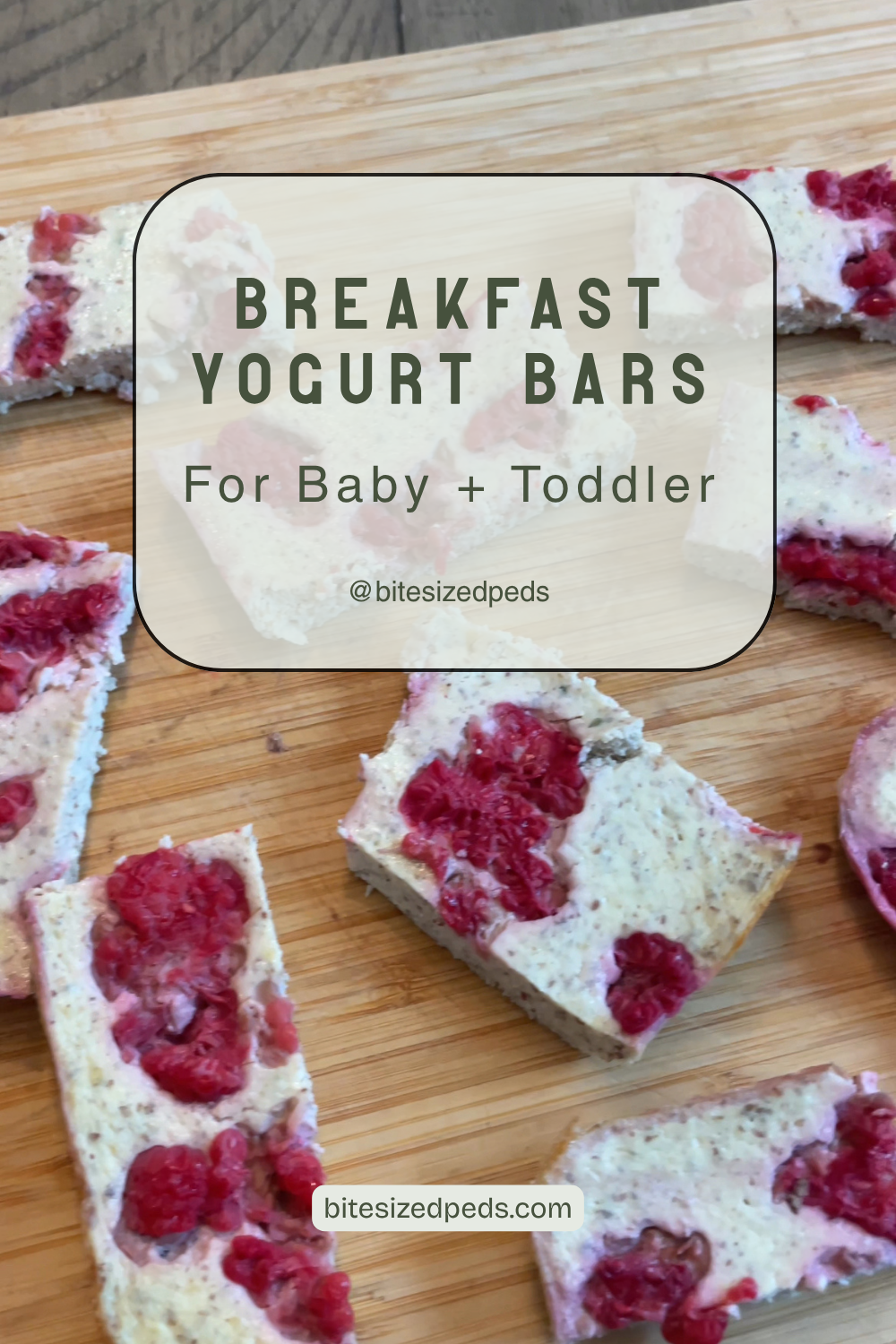
If you’re looking for a recipe to make in bulk for your baby today is your lucky day! This is honestly one of the easiest baby meal prep ideas you'll ever come across. Six ingredients, five minutes to throw together, one bowl to mix, twenty minutes in the oven, and you have a week's worth of baby meal ideas ready to pull from the fridge. So simple and convenient!
As a pediatric nurse practitioner and a fellow food allergy mom, I love these bars for more reasons than just convenience. They're packed with iron and omega 3-s which are crucial for brain development. They’re developmentally appropriate for babies starting solids, and a sneaky easy way to keep allergens in regular rotation once you've introduced them. They work beautifully for baby-led weaning and are just as perfect as a toddler snack idea for older siblings too.
Nutrient-Packed
Every ingredient in this recipe is pulling its weight. While these bars are super cute to make for baby, and just as amazingly convenient for mom…. it's doing REAL nutritional work.
Greek Yogurt is packed with protein, probiotics for your baby's developing gut, and calcium. It also contains dairy — one of the top nine allergens — which makes it a great vehicle for keeping dairy in the rotation once it's been introduced.
Eggs are one of the most nutrient-dense foods you can offer a baby starting solids. Rich in choline for brain development, protein, healthy fats, and iron. Also a top allergen. Also delicious in bar form apparently.
Ground Flax or Chia Blend gives you omega-3 fatty acids for brain growth and fiber for that little gut. Easy to sneak into basically everything. Our favorite is Tiny Sprouts linked here (CODE: CIERRA10)
Almond Flour adds healthy fats, protein, and another allergen in the mix.
Berries bring antioxidants, natural sweetness, and a pop of color. Mash them in, chop them up, whatever works.
Three allergens — dairy, egg, and almond — in one simple baby-friendly recipe you can make on a Sunday and have ready all week. Because you deserve simplicity that gives you peace of mind for baby!
Pro tip:
Introduce the top nine allergenic foods one at a time. The top nine allergenic foods are - eggs, peanuts, tree nuts, dairy, wheat, soy, fish, shellfish, sesame.
Early and Often. What the research says about Allergen Introduction.
For a long time parents were told to delay allergenic foods….. “Wait until one.”…. “Be careful…..”
The research has since completely changed course. The landmark LEAP trial showed that early introduction of peanut reduced the risk of peanut allergy by 81% in high-risk infants. Follow-up studies tracked those same kids into adolescence and found the protection lasted — at age 12, kids who had peanut introduced early had a peanut allergy rate of just 4.4%, compared to 15.4% in those who had avoided it.
Current guidelines from the AAP and NIAID now recommend introducing peanut, egg, and other major allergens starting around 4 to 6 months — for all babies, not just high-risk ones.
As a food allergy mom myself, I know how anxiety-inducing allergen introduction can feel when you're in the thick of starting solids. I've been on that side of the table. The fear is real. But the evidence is really clear — delaying doesn't protect your baby. Introducing early and keeping allergens in regula
r rotation is what builds tolerance.
Allergens should be introduced ONE AT A TIME so you can easily distinguish between which one you baby has a reaction to, if they do.
Early. Often. AND Consistently.
Because introducing once doesn’t offer protection. Once we introduce an allergenic food, it is crucial to keeping that food in the rotation (at least 2-3 times a week) to prevent developing an allergy after a one time exposure.
These bars make that easy. Once you've safely introduced each allergen individually, you won't have to think about it anymore. Bake a pan. Done. Dairy, egg, and almond are showing up at breakfast every single day without any extra effort. Whether you're doing baby-led weaning, purées, or a mix — these fit seamlessly into your routine.
Pro tip:
If your baby has severe eczema, an existing food allergy, or you have any concerns about their risk level, loop in your pediatrician before introducing allergens at home.
Berry Yogurt Bar Recipe
Ingredients:
1 cup plain whole milk Greek yogurt
2 eggs
2 tbsp Tiny Sprouts or other ground flax/chia blend
1/2 tsp vanilla
1 tbsp almond flour
Berries for topping — mashed or finely chopped
Instructions:
Mix everything together in one bowl until smooth. Pour into a greased 8x8 or 8x10 baking dish. Add berries on top.
Bake at 350 degrees for 20 minutes. Cool completely. Cut into two-inch strips.
Store in the fridge for up to 5 days or freeze individually for up to a month.
Suitable for 6+ months. Introduce dairy, egg, and almond separately before serving this recipe. You could also opt to mash these up and serve them on a spoon if that works best for you!
Why I Keep Coming Back to This Recipe
It's simple. It's fast. It works as a baby meal idea, a toddler snack idea, and honestly for the whole family. My kids eat these. I eat these. They come together in the time it takes to drink your morning coffee (may your coffee be hot this morning!) and they're ready to pull from the fridge all week.
But more than that — they take something that can feel overwhelming, allergen rotation, and gives you the confidence to keep serving them!
The first 1,000 days matter. And it doesn't have to be complicated to count. You’ve got. this!
Before you Go
Before you go — two ways to keep the momentum going:
Grab my free Sample Feeding Schedulees — a simple, guide to timing solids with confidence including when to introduce common allerens. Sample schedules from 6 monhts to 12 months showing you how to balance bottles, naps, allergens, and meal times. Get it here!
Or if you're ready to go deeper, my Recipe Bundle has 50+ family-friendly recipes with baby and toddler modifications built right in — including more allergen-friendly options like this one. Grab it here!
And if you want to feel truly prepared for every part of the starting solids journey, our Safe Start to Solids consults covers developmental readiness, allergen introduction, textures, gagging vs. choking, and everything in between. Book your spot here!
Have the best day ever!
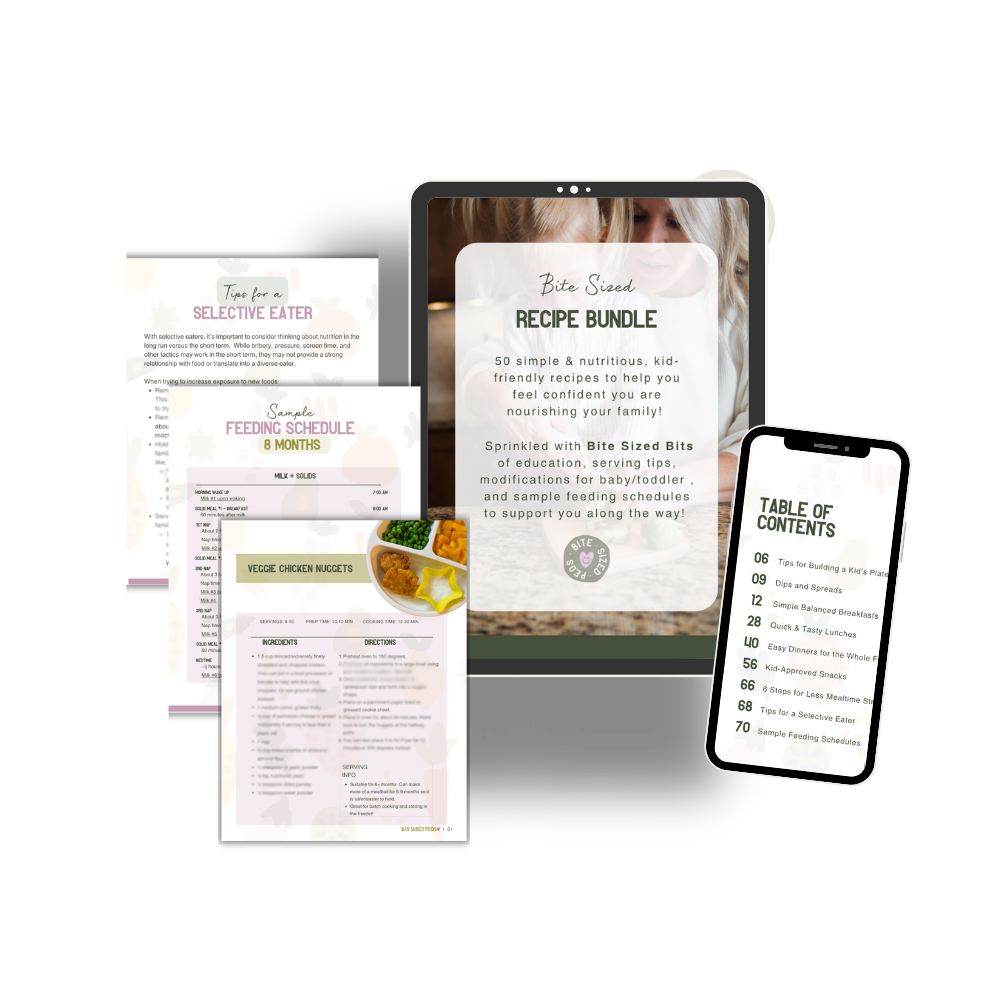
Bite Sized Recipe Bundle
Packed with 50 simple, family-friendly recipes that allow you to have confidence in your feeding journey with your little one, showing you how to modify family meals to be safe for baby. Not to mention, it is also sprinkled with
Bite Sized Bits of education
Serving tips
8 Sample Feeding Schedules from 6-12 months (showing your how to wean bottle feeds)
Tips for reducing mealtime stress and navigating picky eating
Giving you a framework for your feeding journey with your baby!
-
Medical/General: The content, information, opinions, and suggestions listed here have been created with typically developing children and babies in mind. The information here is generalized for a broad audience. The information here should by no means be used as a substitute for medical advice or for any circumstance be used in place of emergency services. Your child is an individual and may have needs or considerations beyond generally accepted practices. If your child has underlying medical or developmental differences, including but not limited to prematurity, developmental delay, sensory processing differences, gastrointestinal differences, cardiopulmonary disease processes, or neurological differences, we strongly recommend you discuss your child's plan with the child's doctor, health care provider. By accessing this site and the information in it, you acknowledge and agree that you are accepting responsibility for your child’s health and well-being. By using and accepting the information on this site, the author (Cierra Crowley) is not responsible for any adverse effects or consequences resulting from the use of any suggestions discussed. It is important to talk to your child’s pediatrician or medical provider to start anything new or make any changes.
Affiliation: this page contains affiliate links from which I can earn small commissions (at no additional cost to you).
-
Du Toit, G., Roberts, G., Sayre, P. H., Bahnson, H. T., Radulovic, S., Santos, A. F., Brough, H. A., Phippard, D., Basting, M., Feeney, M., Turcanu, V., Sever, M. L., Lou Plaut, M., Thomas, K., Fleischer, D. M., & Lack, G. (2015). Randomized trial of peanut consumption in infants at risk for peanut allergy. New England Journal of Medicine, 372(9), 803–813. https://doi.org/10.1056/NEJMoa1414850
Du Toit, G., Huffaker, M. F., Radulovic, S., Feeney, M., Hallatt, A., Shersby, A., Amir, M., Bahnson, H. T., Plaut, M., & Lack, G. (2024). Follow-up to adolescence after early peanut introduction for allergy prevention. NEJM Evidence, 3(6). https://doi.org/10.1056/EVIDoa2300311
Togias, A., Cooper, S. F., Acebal, M. L., Assa'ad, A., Baker, J. R., Beck, L. A., Block, J., Byrd-Bredbenner, C., Chan, E. S., Eichenfield, L. F., Fleischer, D. M., Fuchs, G. J., Furuta, G. T., Greenhawt, M. J., Gupta, R. S., Habich, M., Jones, S. M., Keaton, K., Muraro, A., … Boyce, J. A. (2017). Addendum guidelines for the prevention of peanut allergy in the United States. Journal of Allergy and Clinical Immunology, 139(1), 29–44. https://doi.org/10.1016/j.jaci.2016.10.010
Gabryszewski, S. J., Dudley, J., Faerber, J. A., Grundmeier, R. W., Fiks, A. G., Spergel, J. M., & Hill, D. A. (2025). Guidelines for early food introduction and patterns of food allergy. Pediatrics, 156(5), e2024070516. https://doi.org/10.1542/peds.2024-070516
National Institute of Allergy and Infectious Diseases. (2024, May 28). Introducing peanut in infancy prevents peanut allergy into adolescence. National Institutes of Health. https://www.nih.gov/news-events/news-releases/introducing-peanut-infancy-prevents-peanut-allergy-into-adolescence
Cierra Crowley, MSN, CPNP is a board-certified Pediatric Nurse Practitioner, adjunct assistant professor, and mom of three. She is the founder of Bite Sized Peds, a pediatric health education platform serving families and pediatric professionals.
This post is for educational purposes only and does not constitute medical advice. Always consult your child's pediatrician with specific concerns about allergen introduction or food allergies.