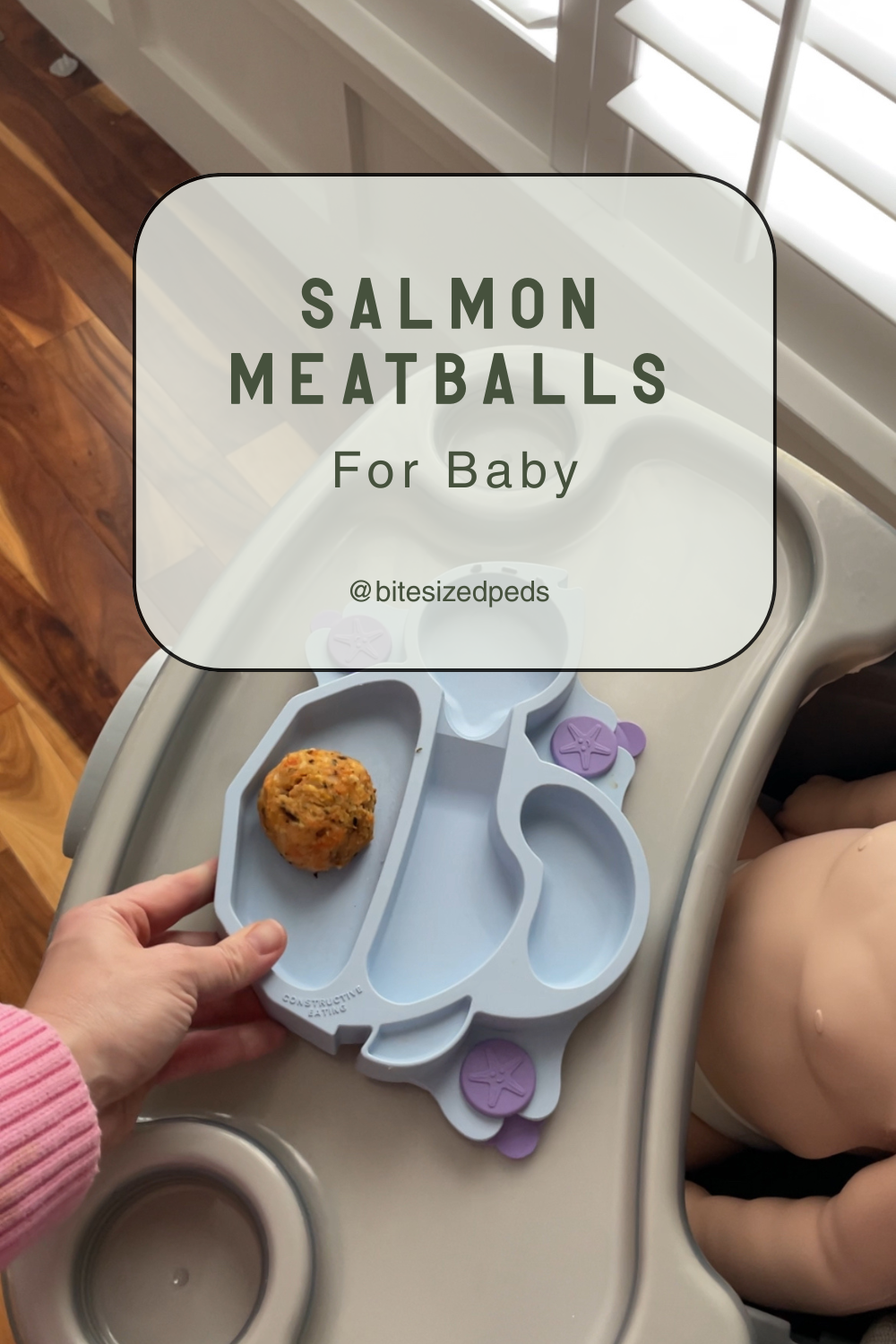
Viral Salmon Meatballs For Baby
An important reminder:
This post and anything on this website is for educational purposes only. It should not be used as medical advice or in place of or to delay seeking medical attention. Every child is different and has different needs. Your child’s provider can help you figure out the best management plan for your specific situation.
JUMP TO
Okay so, you've heard you're supposed to introduce fish to your baby, you know it's on the allergen list, and now you're standing in the grocery aisle trying to decide if this is the week you finally do it or how the heck to do it…. Especially if you aren’t a family that regularly eats fish.. And whether that rash last week was related to the food you introduced or just drool.
I see you. Feeding your baby can feel like a lot, especially when everyone online has an opinion.
Fish is one of those allergens that tends to sit in the back of the queue when parents are working through the big nine. Sometimes it feels like a stretch when your baby is just figuring out purees and finger foods. But here's the thing: salmon might be one of the most worthwhile allergens to get into your baby's rotation, and these meatballs make it genuinely easy to do that
First, Let's Talk About Why Salmon for Baby
Fish is one of the top nine allergens, which means yes, it needs to be introduced intentionally, one at a time, and tracked. The goal is to introduce it and then keep it in rotation. The research consistently points us toward early introduction as protective, not risky.
The American Academy of Pediatrics and NIAID guidelines now recommend introducing major allergens, including fish, starting around 4 to 6 months, as soon as your baby is developmentally ready for solids. Waiting doesn't reduce risk. In most cases, waiting increases it. So if salmon has been sitting on your mental "eventually" list, let's just make it the plan for this week.
(If you want the full breakdown on how to introduce allergens step by step, including what a reaction looks like and what to do if one happens, I have a full blog on that [link here]. Come back after you read this one.)
The Brain Food
Fish like salmon are specifically worth prioritizing beyond just checking the allergen box.
Salmon is one of the richest dietary sources of DHA — a long-chain omega-3 fatty acid that is critical for brain development in infancy and early childhood. DHA is a structural component of the brain and retina, meaning your baby's brain is literally using it to build itself. The first two years of life represent the most rapid period of brain growth your child will ever experience, and DHA plays a starring role in that process.
Research shows that adequate DHA intake in infancy is associated with improved cognitive development and visual acuity outcomes. The FDA and EPA both recognize fatty fish like salmon as among the best dietary sources of DHA and recommend it as a key part of infant and young child nutrition, specifically noting that children should be eating fish 2 times per week
Two salmon fillets in this recipe give you a meaningful dose of DHA in every single meatball. And this recipe makes around 28 of them, so you're meal-prepping brain food for the whole week.
Two Allergens in One Recipe: What You Need to Know Before You Make It
This recipe contains salmon (fish) and dairy from the milk used to soak the breadcrumbs and the cheese.
Before you serve these meatballs, both salmon and dairy need to have already been introduced individually.
If your baby hasn't had dairy yet, swap the milk in the breadcrumb soak for breast milk or water, and leave out the cheese.
If your baby hasn't had salmon yet: this is a great vehicle for introducing it, start with a small amount and watch for 5-10 minutes for signs of a reaction.
How to Serve These Based on Age
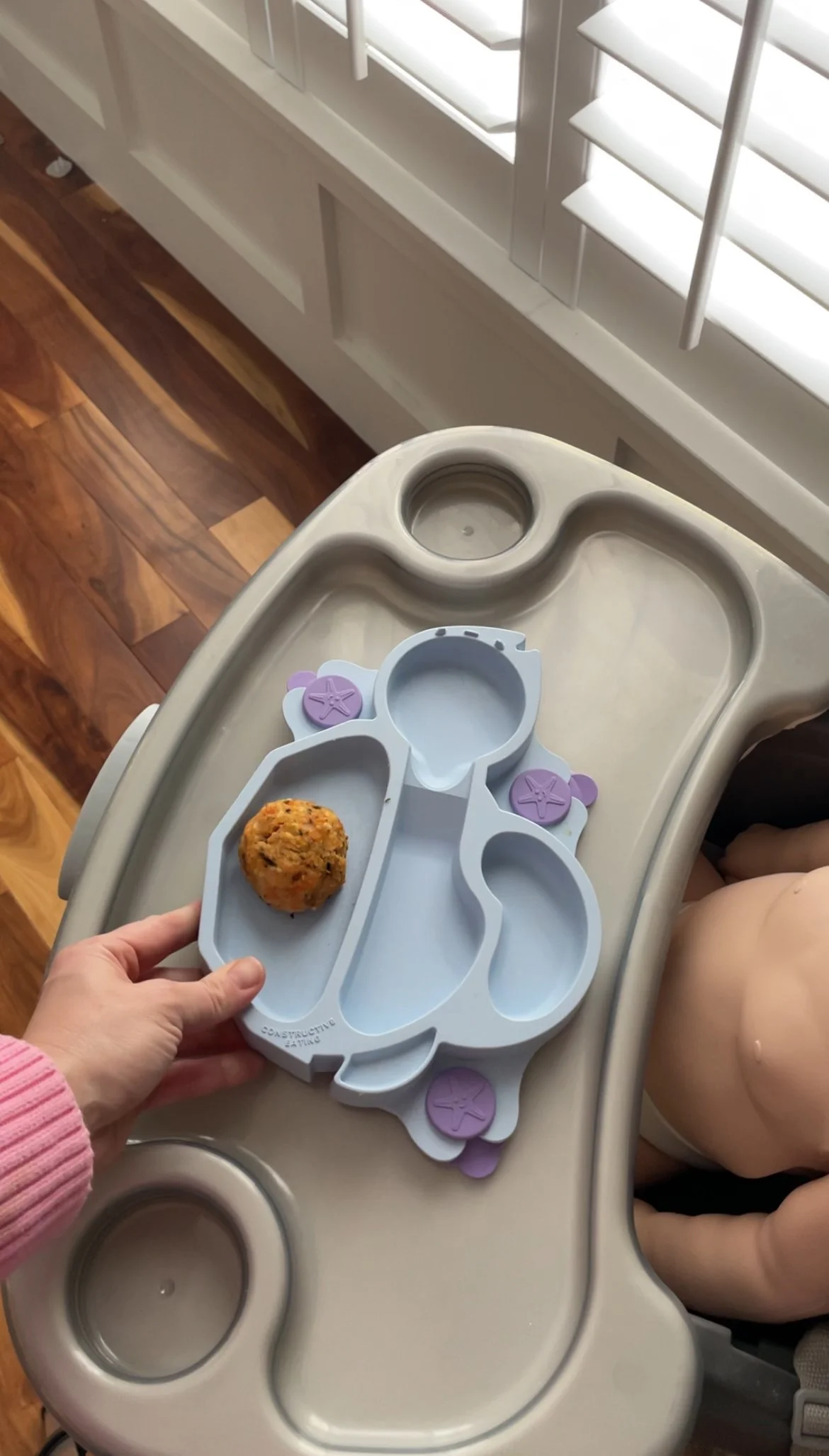
6 to 9 months: Make the balls in 2+ inch diameter. This allows baby to easily pick it up, hold onto it, and bring it to their mouth. Remember, smaller doesn’t always mean safer. Smaller pieces of food at this stage may be harder for baby to eat, as they haven’t developed the oral motor skills just yet. Meaning, smaller pieces may actually increase the risk of choking. These meatballs are a perfect squishable consistency.
9 to 12 months: Offer in bite sized pieces
12 months and up: Serve whole with a dipping sauce — these are great with plain whole milk Greek yogurt or a little hummus on the side, which also serves as a fun sensory experience for toddlers who want to dip everything in sight.
Making these more exciting for toddlers: Toddlers who are used to chicken nuggets or plain foods may need a little runway. Try serving these with a dipping sauce they already love, cutting them open to show them what's inside, or letting them help form the meatballs before baking. Involvement in preparation genuinely increases the likelihood of tasting for this age group.
Viral Salmon Meatballs
Ingredients
1 tablespoon Schnucks olive oil
1 onion, finely chopped
1 carrot, peeled and finely grated
1/2 cup Schnucks breadcrumbs (optional, see notes)
2 tablespoons milk (optional see notes)
1 small pear, peeled and grated
1 small apple, peeled and grated
1 TBSP Schnucks Garlic powder
2 teaspoons freshly chopped Schnucks parsley
1 teaspoon smoked paprika
3 Schnucks salmon fillets (alternatively, you could swap for 1 lb of ground chicken)
Instructions
Preheat oven to 200c / 400f and line a baking tray with baking paper.
Heat the oil in a pan and fry the onion and carrot over a low heat until soft. (For around 5 mins)
In a small bowl, pour the milk over the breadcrumbs and allow to sit for 5 mins.
Add all the ingredients, apart from the ground salmon, to a mixing bowl and mix with your hands until all the ingredients are mixed together. Add the thawed salmon by pulling it apart and mincing it with your hands. As you are pulling apart the salmon, check for any small fish bones that may be present and then gently mix the ingredients with your hands until just combined.
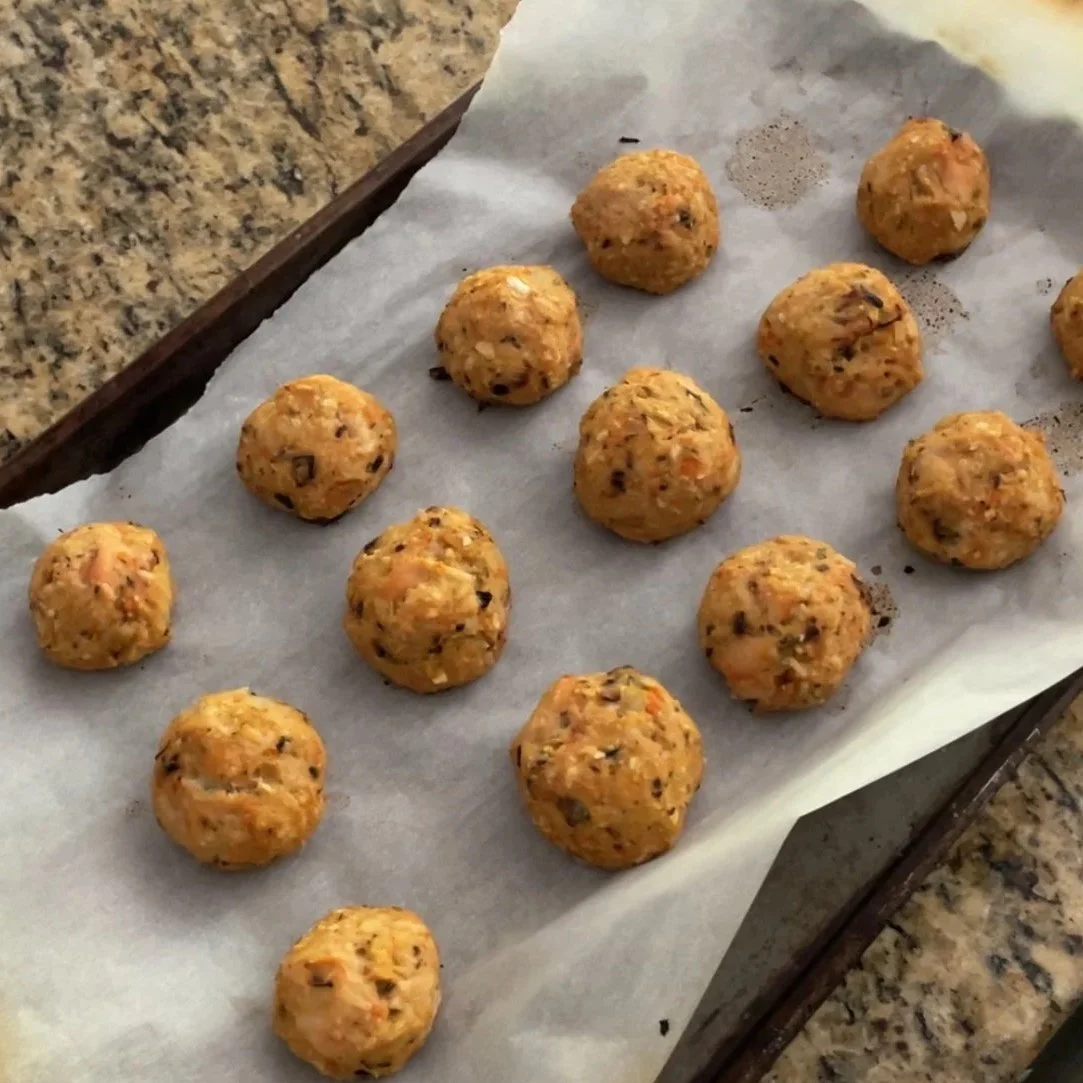
Shape the mixture into 2 inch balls and place on the lined baking tray. (I made 28 balls.)
Place in the oven and bake for approximately. 20 mins, until golden and cooked through.
Notes
Breadcrumb and Milk mixture - Added to produce a lighter, more tender ball. If you have a dairy/gluten allergy, then you can leave out dairy and opt for whatever milk your family chooses. Additionally, if you have not yet introduced dairy or fish to your baby, be aware that this recipe contains two common allergens (milk and salmon). If this is your first time with either dairy or salmon, choose to introduce salmon and swap the dairy milk in this recipe for breast milk or water.
Finely grate the carrots and fruit - If you have a box grater, then use the smaller shredding holes designed to finely grate.The finely grated textures makes it softer and easier to eat for baby. The larger holes on the grater are fine, just will add more texture.
Wrapping up
These meatballs are convenient, freezer-friendly, and the kind of recipe that does a lot of work without requiring a lot from you. But more than that, they're a genuinely low-stress way to introduce salmon, keep it in rotation, and give your baby an excellent source of the DHA their brain needs right now, during the window when it matters most.
Before you go
If you're in the thick of starting solids and want to feel truly confident — not just have a pile of recipes — our Safe Start to Solids consult is built exactly for that. We cover developmental readiness, how to introduce allergens step by step, textures, gagging vs. choking, and everything in between so you're not piecing it together from fifteen different Instagram posts. Learn more here
And if you haven't yet grabbed the free Sample Feeding Schedules, that's a great place to start — it shows you how to balance bottles, solids, allergens, and nap times without losing your mind. Grab your copy here!
-
Medical/General: The content, information, opinions, and suggestions listed here have been created with typically developing children and babies in mind. The information here is generalized for a broad audience. The information here should by no means be used as a substitute for medical advice or for any circumstance be used in place of emergency services. Your child is an individual and may have needs or considerations beyond generally accepted practices. If your child has underlying medical or developmental differences, including but not limited to prematurity, developmental delay, sensory processing differences, gastrointestinal differences, cardiopulmonary disease processes, or neurological differences, we strongly recommend you discuss your child's plan with the child's doctor, health care provider. By accessing this site and the information in it, you acknowledge and agree that you are accepting responsibility for your child’s health and well-being. By using and accepting the information on this site, the author (Cierra Crowley) is not responsible for any adverse effects or consequences resulting from the use of any suggestions discussed. It is important to talk to your child’s pediatrician or medical provider to start anything new or make any changes.
Affiliation: this page contains affiliate links from which I can earn small commissions (at no additional cost to you).
-
Abrams, E. M., Shaker, M., Stukus, D., Mack, D. P., & Greenhawt, M. (2023). Updates in Food Allergy Prevention in Children. Pediatrics, 152(5), e2023062836. https://doi.org/10.1542/peds.2023-062836
DiNicolantonio, J. J., & O'Keefe, J. H. (2020). The Importance of Marine Omega-3s for Brain Development and the Prevention and Treatment of Behavior, Mood, and Other Brain Disorders. Nutrients, 12(8), 2333. https://doi.org/10.3390/nu12082333
Scarpone R, Kimkool P, Ierodiakonou D, et al. Timing of Allergenic Food Introduction and Risk of Immunoglobulin E–Mediated Food Allergy: A Systematic Review and Meta-analysis. JAMA Pediatr. 2023;177(5):489–497. doi:10.1001/jamapediatrics.2023.0142
National Institute of Allergy and Infectious Diseases. Addendum Guidelines for the Prevention of Peanut Allergy in the United States. Published January 2017. https://www.niaid.nih.gov/diseases-conditions/guidelines-clinicians-and-patients-food-allergy
U.S. Food and Drug Administration & U.S. Environmental Protection Agency. Advice About Eating Fish. Updated October 2021. https://www.fda.gov/food/consumers/advice-about-eating-fish
Du Toit G, Roberts G, Sayre PH, et al. Randomized trial of peanut consumption in infants at risk for peanut allergy (LEAP Trial). New England Journal of Medicine. 2015;372(9):803–813. doi:10.1056/NEJMoa1414850 https://pubmed.ncbi.nlm.nih.gov/25705822/
Mennella JA, Jagnow CP, Beauchamp GK. Prenatal and postnatal flavor learning by human infants. Pediatrics. 2001;107(6):E88. doi:10.1542/peds.107.6.e88 https://pubmed.ncbi.nlm.nih.gov/11389286/
Cierra Crowley, MSN, CPNP is a board-certified Pediatric Nurse Practitioner, adjunct assistant professor, and mom of three. She is the founder of Bite Sized Peds, a pediatric health education platform serving families and pediatric professionals.
This post is for educational purposes only and does not constitute medical advice. Always consult your child's pediatrician with specific concerns about allergen introduction or food allergies.